二氧化碳濃度增加導致全球各地植物生長速度增加,這種現象被稱為「全球綠化」(global greening)。有研究發現,缺水壓力增加可能抵消全球綠化效應。
,全球暖化改變了水分蒸散狀況,這又回過頭來影響植物生長時光合作用的速度。未來,植物吸收人類排放的二氧化碳的能力可能會「大幅減少」──根據政府間氣候變遷專門委員會(IPCC)近期的《氣候變遷與土地》特別報告,目前人類排放的溫室氣體有30%由土地吸收。
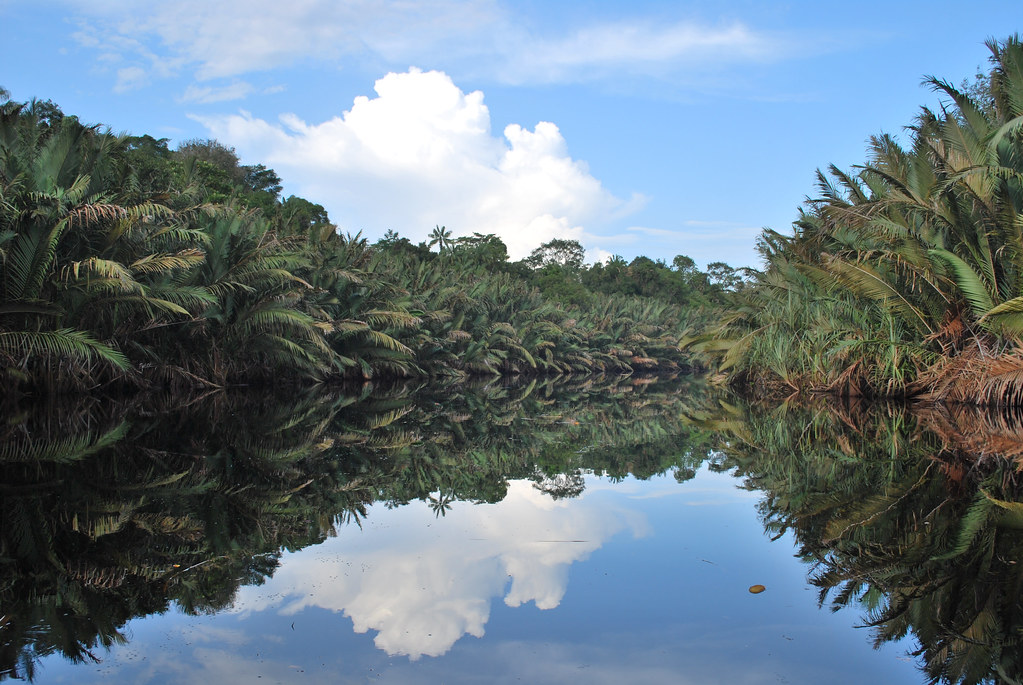
蘇門答臘貝爾巴克國家公園內生長的沼澤森林。 (CC BY-NC-ND 2.0)
綠化
研究透過衛星和地面測量發現,全世界變得越來越「綠」。自工業革命開始以來,植物生長的速度和植物覆蓋的土地面積都有所增加。
這種「全球綠化」主要是大氣中二氧化碳含量上升所致。植物在光合作用過程中使用二氧化碳,隨著人類排放的二氧化碳越來越多,植物的生長速度越來越快。
二氧化碳濃度上升對植物生長的影響被稱為「二氧化碳施肥效應」。 2016年發表的一項研究發現,二氧化碳施肥因素佔全球綠化的70%左右。 (不過,Carbon Brief最近介紹的另一項研究對二氧化碳施肥促成全球綠化的程度提出質疑。)
了解全球綠化的成因及其後果非常重要,因為這種現象對移除大氣中的二氧化碳有關鍵作用。
根據IPCC最近的土地報告,目前人類排放的溫室氣體有30%被土地所吸收,其中大部分是透過植物來吸收。
過去的研究顯示,隨著大氣中二氧化碳增加,植物生長速度將繼續增加 ,這表示土地隨著時間的推移會吸收更多的碳。
然而,這份發表在「科學進展」期刊上的新研究發現,水資源壓力上升可能會抵消二氧化碳施肥效應。研究報告的主要作者、中國廣東中山大學全球變化生態學研究員袁文平教授說:
「1990年代末之前,全球植被生長受益於二氧化碳施肥效應。然而,我們的研究顯示,1990年代末全球水分蒸散開始增加,全球植被生長呈現下降趨勢。」
蒸散的價值
在這項研究中,作者用「蒸氣壓力差」(vapour-pressure deficit, VPD)作為測量指標。
VPD是空氣中水蒸氣量與空氣中水蒸氣飽和點之間的差值。袁文平說,這個差值可用來瞭解大氣中的「水勢」。
「基本上,如果大氣中的水勢大,即VPD大,則水從土壤和植物中蒸散的速度快且強。」
植物透過關閉氣孔(植物用來吸收光合作用所需氣體的構造)因應高VPD,防止水分流失。這導致光合作用減緩,因此生長變慢。
研究也發現,VPD增加也會使植物更快乾燥枯萎,因此可能在與乾旱有關的森林死亡中發揮作用。
為了瞭解近幾十年來VPD的變化,作者分析了幾個全球氣候資料集,尤其是植被區域的VPD。
他們發現1990年代末以來,植被地區的VPD「劇烈」增加。以下研究圖表顯示VPD從1850年到現在的增長情況。在圖表上,顏色代表顯示不同氣候資料集的結果。
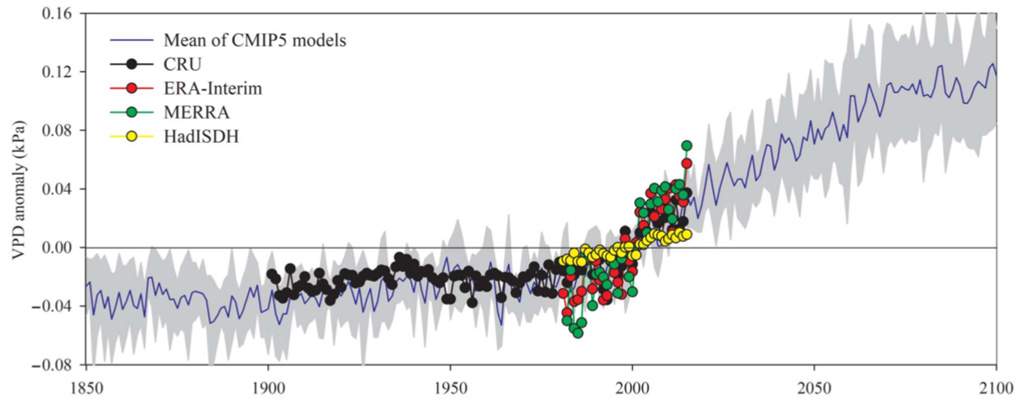
作者還發現,植被地區的VPD未來可能繼續上升。
袁文平說,VPD的增加可能受氣候變遷影響。
由於氣溫升高,空氣中水蒸氣要達到飽和的門檻提高(因為溫暖的空氣可以保留更多的水分)。
然而,同時間大氣中的水蒸氣量正在減少。根據這項新研究,這可能是因為從世界海洋蒸發的水量正在減少。袁文平說:
「全球暖化會降低風速,進而減少海洋表面的水分蒸發。」
他說這表示著隨著氣候變遷,空氣中水蒸氣量與空氣中水蒸氣飽和的門檻之間的差距越來越大。
從綠色到棕色
在研究的下一個部分,作者用衛星資料觀察了1990年代以來全球植物生長率的變化。
以下摘自研究的地圖顯示,1982~1998年(上圖)和1999~2015年(下圖)世界部分地區的綠化速率變化。紅色表示綠化速率在此期間減少,綠色表示速率增加。
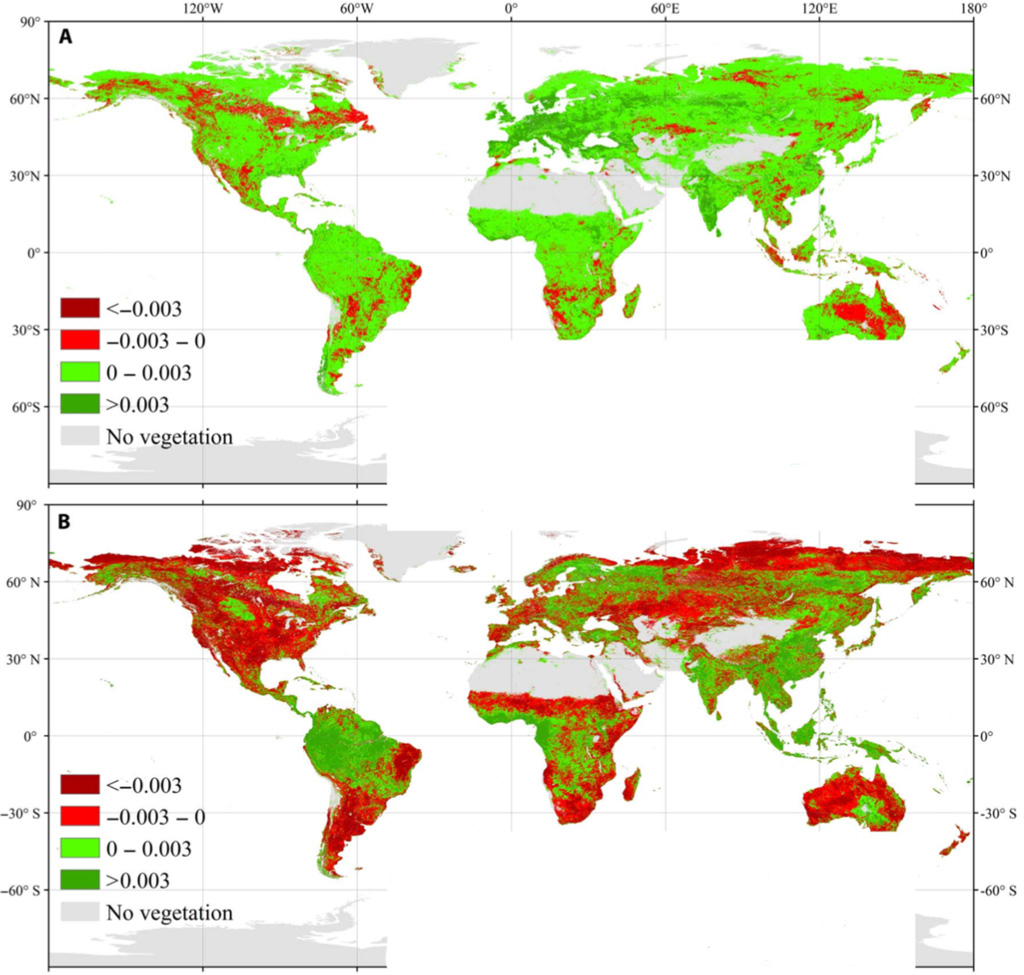
該研究顯示,1990年代末以來,綠化速率「持續且普遍下降」。
研究人員接著利用模型整理1990年代末以來可能導致植物生長速率減緩的因素。袁文平說:
「結果顯示,1990年代後期以來,VPD增加是導致植被生長減少的主要原因。」
萎縮的碳匯
在未來,氣候變遷可能會導致VPD繼續增加,對植物生長速度產生更大的影響,袁文平說:
「植被生長速度下降將大大降低植物吸收大氣二氧化碳的能力。如果其他條件沒有改變,大氣中二氧化碳濃度將會增加,導致更強的溫室效應。」
過去的研究發現,土壤養分供應減少可能限制二氧化碳施肥效應。尤其缺乏氮和磷會限制植物生長。
這項新研究未考慮養分供應的變化如何影響植物生長。然而,養份相對比較不會隨著時間的推移而變化,但是缺水逆境卻會隨著氣候暖化繼續增加。袁說:
「我們的研究結果發現VPD將隨著暖化持續增加,直到本世紀末。因此,VPD的影響將變得更加顯著。」
未參與研究的波士頓大學全球綠化研究員Ranga Myneni教授表示,這樣的研究結果突顯了缺水逆境帶給植物和土地碳匯的威脅:
「缺水逆境導致植物褐變,尤其是在熱帶和北方森林中。對後者來說,這種氣候變化引發火災和蟲害,我們在過去20年間已可觀察到。作者提醒我們應注意植物日益增加的缺水逆境。」
Rising water stress could counteract 'global greening', study says by Daisy DunneThe increased growth rate of plants seen worldwide in response to rising CO2 levels – a phenomenon known as "global greening" – could be stalled by growing water stress, a study finds.
Global warming is driving changes to water vapour levels, the research finds, which could, in turn, be affecting the rate of plant photosynthesis – the process underpinning plant growth.
The findings suggest that, in the future, the ability of plants to absorb the CO2 emitted by humans may be "substantially reduced", the lead author tells Carbon Brief.
At present, the land takes in 30% of the greenhouse gases emitted by humans, according to a report by the Intergovernmental Panel on Climate Change ().
The findings "do a credible job of bringing the increasing water stress on plants to the fore", another plant scientist tells Carbon Brief.
Turning green
Research using and measurements shows that the world has been getting "greener". That is, both the rate at which plants are growing and the amount of land covered by plants has increased since the start of the .
This "global greening" has been driven largely by rising CO2 levels in the atmosphere. Plants use CO2 during photosynthesis and so, as humans have emitted more and more CO2, plants have grown at an increasingly rapid rate.
The impact of rising CO2 levels on plant growth is known as the "CO2 fertilisation effect". A published in 2016 found that CO2 fertilisation is responsible for around 70% of global greening. (However, a more recent study covered by questioned the extent to which CO2 fertilisation is responsible for global greening.)
Understanding what is driving global greening and how this could change is important because the phenomenon plays a in removing CO2 from the atmosphere.
The land currently absorbs around 30% of the greenhouse gases emitted by humans, according to the IPCC's recent , with plants being responsible for the of this land carbon.
Previous research has suggested that, as CO2 levels rise, plant growth rates will continue to increase – meaning more carbon is taken up by the land with time.
However, the new study, published in , finds that rising water stress levels could be counteracting the CO2 fertilisation effect, says study lead author , a global change ecology researcher from in Guangdong, China. He tells Carbon Brief:
"Global vegetation growth was enhanced before the late 1990s – benefiting from the CO2 fertilisation effect. However, our study shows that global vegetation growth has shown a decreasing trend since the late 1990s, when the global [water vapour changes] started to increase."
Vapour's value
For the study, the authors looked at a measure called the "" – or VPD.
This measure is the difference between the amount of water vapour in the air and the point at which water vapour in the air becomes saturated. The measure gives an idea of the "water potential" in the atmosphere, Yuan explains:
"Basically, if the water potential is larger in the atmosphere – as in, if VPD is larger – water will dissipate faster and stronger from soil and plants."
Plants react to higher VPD by closing their stomata – the pores plants use to absorb gases needed for photosynthesis – in order to prevent water loss, Yuan says. This causes them to conduct photosynthesis at a slower rate and, so, grow more slowly, he says.
Increased VPD also causes plants to dry out faster and thus can play a role in drought-related forest death, the study adds.
To explore how VPD has changed in recent decades, the authors analysed several global climate datasets. They looked specifically at VPD of areas with vegetation.
They found that VPD of vegetated areas has increased "strongly" since the late 1990s. The chart below, taken from the study, shows how VPD has increased from 1850 to present day. On the chart, colour is used to show the results from the different climate data sets.
Global mean vapour pressure deficit anomalies (VPD) of vegetated areas from 1850 to present day. Anomalies are relative to the mean of 1982-2015. Colour is used to show the results from the different climate data sets. Blue line and grey area illustrate the mean and standard deviation of VPD simulated by climate models using the scenario "". Source: Yuan et al. (2019)
The authors also find that VPD of land with vegetation is likely to keep rising in the future.
Increasing VPD is likely being influenced by climate change, Yuan says.
The level at which water vapour in the air becomes saturated is rising as a result of warming temperatures, he explains. (This is because warmer air can hold .)
However, at the same time, the amount of water vapour in the atmosphere is decreasing. This could be because the amount of water evaporating from the world's oceans is declining, according to the new study. Yuan says:
"Global warming can decrease wind speed, which, in turn, decreases the water evaporation from the ocean surface."
This means that the deficit between the amount of water vapour in the air and the level at which water pressure in the air becomes saturated is growing ever larger as the climate changes, he says.
Green to brown
For the next part of the study, the authors used satellite data to observe how global plant growth rates have changed since the 1990s.
The maps below, taken from the study, show how the rate of greening changed in parts of the world between 1982-1998 (top) and 1999-2015 (bottom). On the maps, red indicates that the rate of greening decreased in the period, while green indicates that the rate increased.
Rates of greening across the world between 1982-1998 (top) and 1999-2015 (bottom). Red indicates that the rate of greening decreased in the period, while green indicates that the rate increased. Grey shows land without vegetation. Source: Yuan et al. (2019)
The maps indicate that there have been "persistent and widespread decreases" to the rate of greening since the late 1990s, the study says.
The researchers then used modelling to tease apart the factors that could have driven plant growth decreases since the late 1990s. Yuan says:
"The results show the increasing VPD since the late 1990s is a dominant cause for decreased vegetation growth."
Shrinking sink
In the future, climate change is likely to cause VPD to increase further – which could have even larger impacts on the rate of plant growth, Yuan says:
"Decreased rates of vegetation growth will substantially reduce the ability of plants to absorb atmospheric CO2. The CO2 concentration in the atmosphere will increase, if other conditions did not change, which will result in a stronger greenhouse gas effect."
Previous research has shown that the CO2 fertilisation effect could be further constrained by limits to . In particular, a lack of could limit plant growth as CO2 levels rise.
The new study did not consider how changing nutrient availability could affect plant growth. However, in comparison to nutrient availability limitations – which are likely to remain steady over time, water stress could continue to increase as the climate warms, Yuan says:
"Our results find that VPD will continuously increase until the end of this century with climate warming and, therefore, the impacts of VPD will get more important."
The findings highlight the threat that water stress poses to plants and, so, the land sink, says , a researcher of global greening from , who was not involved in the study. He tells Carbon Brief:
"Water stress will lead to browning, especially in tropical and boreal forests. In the latter, such climatic changes encourage fires and insect outbreaks, which we have seen during the past 20 years. The authors do a credible job of bringing the increasing water stress on plants to the fore."
※ 全文及圖片詳見:()
作者
如果有一件事是重要的,如果能為孩子實現一個願望,那就是人類與大自然和諧共存。
於特有生物研究保育中心服務,小鳥和棲地是主要的研究對象。是龜毛的讀者,認為龜毛是探索世界的美德。
本站聲明:網站內容來源環境資訊中心https://e-info.org.tw/,如有侵權,請聯繫我們,我們將及時處理
【精選家事打掃相關資訊】
不能忽略的居家環境,幫您清洗冷氣機,過敏不再找麻煩!
床墊清潔服務哪裡找? 專業達人到府清潔
清潔床墊如何輕鬆簡單DIY ?
床墊清潔難處理,專業達人教你強效清理
Orignal From: 暖化有助植物生長? 研究:缺水會抵消「全球綠化」效果
留言
張貼留言